

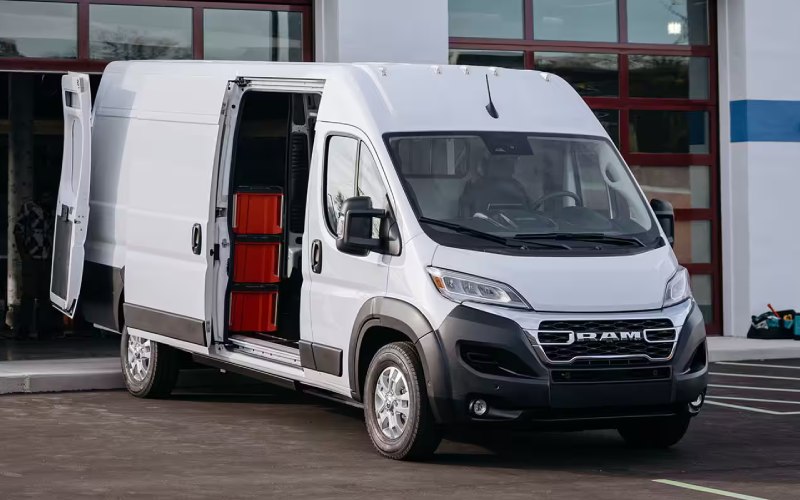
Marshall Motor Company – How Long Does It Take to Charge a 2025 Ram ProMaster EV for Businesses around Hays, KS?
Charging time depends on the charger you use and how your routes are structured, which is why it makes sense to align charging strategy with your daily operations. The Ram ProMaster® EV supports Level 1, Level 2, and DC fast charging, and each level serves a different use case—top-offs, overnight depot charging, and mid-shift boosts at public stations. When you match the charger to the job, you simplify planning, reduce downtime, and keep your teams productive throughout the day.
For most small and midsize fleets, Level 2 charging is the backbone of an efficient routine. With an available Free2move Charge Level 2 Charger and professional installation by Qmerit, you can set up reliable overnight charging at your facility. That schedule pairs naturally with hub-and-spoke routes where vans depart with a full battery in the morning, complete their deliveries or service calls, and return to the depot by day’s end. If your schedule includes tighter turnarounds or extended mileage windows, public Level 3 DC fast charging becomes your on-demand tool to support mid-shift energy adds. The ProMaster® EV makes it simple to use all three charging levels, allowing you to tailor a program that grows with your business.
- Level 1 charging: A standard 120-volt AC outlet for light top-offs and occasional use.
- Level 2 charging: An available Free2move Charge Level 2 solution, professionally installed by Qmerit, designed for dependable overnight charging at your site.
- Level 3 charging: Public DC fast charging to add energy quickly during busy days or extended routes.
Once you understand what each charging level provides, the next step is aligning your route profile with the van’s estimated combined range. The All-New Ram ProMaster® EV Cargo Van is engineered for up to 164 miles of combined (city/highway) range when loaded with 50% of payload. Many regional operations find that a Level 2 overnight routine comfortably supports daily miles with margin for detours or added stops. And because electric torque excels in stop-and-go contexts, the van naturally supports dense delivery routes and service calls without sacrificing a predictable schedule.
Planning installation is straightforward. Work with Qmerit to evaluate available power, panel capacity, and the ideal placement of your Level 2 chargers for easy ingress and egress. If you run shifts or share vehicles, designate parking lanes to streamline cable management and shorten the time it takes to plug in. As your fleet grows, add chargers in planned phases—your investment scales without disrupting daily operations. When crews travel beyond your home base, build a simple reference map of public DC fast charging along your busiest corridors. That way, if a last-minute add-on call stretches the route, your drivers know exactly where to stop and how long they’ll need to be stationed.
Driver training is the final link. Teach teams how to end routes with sufficient buffer for overnight charging, when to opt for a quick top-off, and how to plan midday DC fast charging only when needed. Reinforce best practices, such as plugging in as soon as the van returns to the depot, checking charger status on shift start, and reviewing route changes that might affect charging windows. These small habits build consistency and keep your schedule on time.
Frequently Asked Questions:
Can my business run solely on Level 2 depot charging?
Many organizations can. If your daily mileage falls comfortably within the van’s combined range estimate and your crews return to base each day, an available Free2move Charge Level 2 setup—installed by Qmerit—typically covers overnight energy needs.
When should I plan for public DC fast charging?
Use Level 3 DC fast charging for extended days, unplanned route extensions, or rapid turnarounds between shifts. It complements, rather than replaces, your Level 2 routine.
How do I decide how many chargers to install?
Start by mapping vans to parking spots and shifts. If vehicles return at similar times, install enough Level 2 ports to avoid bottlenecks and add capacity as your fleet grows.
What about service and driver support?
Choose a partner with commercial EV experience. Marshall Motor Company can help you align vehicles, charging, and training into a plan that keeps your routes predictable while serving McPherson, Hutchinson, and Hays.
A thoughtful charging strategy helps you get the most from your electric vans without overhauling your entire operation. Pair a strong Level 2 foundation with targeted access to public DC fast charging, and train your team to follow simple, consistent habits. With the Ram ProMaster® EV’s compatibility across all three charging levels and its business-focused design, you can scale confidently and keep drivers focused on what matters—serving customers and finishing the day on time. When you are ready to plan your transition, our commercial team is here to help you map routes, infrastructure, and onboarding for a smooth, efficient rollout.
As you evaluate options around Hays, think in terms of workflow rather than just charger speed. The right solution supports your routes today and grows with you tomorrow. One balanced plan, tailored to your team, goes a long way—backed by product engineering made for the job.
Request more 2025 RAM ProMaster EV information
Connect with us


Recent Blog Entries
- Is the 2026 Nissan Frontier Better for Towing than the 2026 Toyota Tacoma around Hays, KS?
- Is the 2026 Nissan Rogue More Comfortable Than the 2026 Honda CR-V for Hutchinson, KS Families?
- Is the 2026 Ram 1500 More Comfortable Than the 2026 GMC Sierra 1500 for Hays, KS Truck Shoppers?
- Can the 2026 Nissan Rogue Tow a Small Camper near McPherson, KS?
- Which Truck Has More Real-World Power — 2026 Ram 1500 or 2026 Chevrolet Silverado 1500 near McPherson, KS?